Could a Baby Be Mistaken for a Polyp in Ultrasound
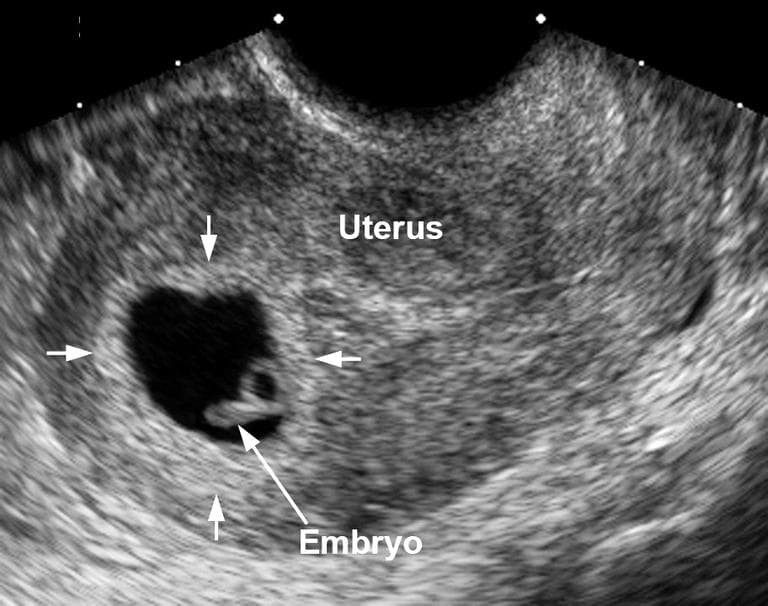
A beautiful, supremely talented young friend of our family recently fell victim to a terrible medical mistake. Newly married, she was having some pelvic pain and bleeding, and the doctor who saw her diagnosed a likely ectopic pregnancy — an embryo that develops outside the womb. Concerned that such pregnancies can turn life-threatening, the doctor prescribed the standard treatment: methotrexate, a drug used for chemotherapy and to help induce abortions.
When our friend returned to exist checked a few days later on, the imaging revealed that in fact, the pregnancy had not been ectopic; information technology was in place, in her uterus. But considering she had taken the methotrexate, a known cause of birth defects, her pregnancy was doomed. She soon miscarried. What may take been a perfectly healthy pregnancy had been ended past well-meant medical treatment.
I assumed her horrifying case was an exceedingly rare medical fluke — until now. A paper just out in the prestigious New England Periodical of Medicine shows that such misdiagnosed pregnancies are part of a blueprint — a pattern that needs to be inverse. "Considerable evidence suggests that mistakes such as these are far from rare," it says.
When I told our friend'south story to the paper's pb writer, Dr. Peter Doubilet, he responded that he knows of "dozens and dozens and dozens of similar cases that have come to lawsuits, and that'south probably the tip of the iceberg." There is even a Facebook group, Misdiagnosed Ectopic, Given Methotrexate, run by a female parent given methotrexate whose girl was born with major birth defects.
The New England Journal of Medicine newspaper stems from a console of international experts who resolved to change medical practice to stop such misdiagnoses. I spoke with Dr. Doubilet, who is senior vice chair of radiology at Brigham and Women'due south Infirmary and a professor of radiology at Harvard Medical Schoolhouse. Our conversation, lightly edited:
Before nosotros go into the nuts and bolts of the problem, what's the result for women of kid-bearing age? What'southward your message to them?
When a woman gets meaning, a number of serious complications can occur early in pregnancy, including miscarriage or ectopic pregnancy. When a md diagnoses these problems inside the first two to three weeks after her missed period, information technology's very traumatic to the patient and it's critically important that the woman and the doctor are confident that the diagnosis is right, because the steps that will exist taken would harm a normal pregnancy if one is present.

It'south become credible over the past two to three years that errors in diagnosis of miscarriage and ectopic pregnancy occur more frequently than they should, and that's why we put together a multi-specialty panel of skillful doctors from radiology, obstetrics-gynecology and emergency medicine to come up with new, more stringent guidelines for diagnosing these complications, taking into business relationship the most contempo research on the subject.
And just to simplify, when a adult female in very early pregnancy has been told that it appears that she has an ectopic pregnancy or a failed pregnancy, information technology would very rarely be overly risky — and often be wise — to expect a couple of days and be sure of the diagnosis before acting?
Yeah. That'southward a very important message. In 2010, I, together with Dr. Carol Benson, wrote an editorial in The Journal of Ultrasound in Medicine entitled "First, practice no harm to early on pregnancies," and that was the key bulletin: Unless the doc is sure that the adult female has a miscarriage or an ectopic pregnancy, the medico should err on the side of waiting, as long as the woman is stable and shows no signs of serious internal bleeding.
If the patient meets definite criteria for a miscarriage or ectopic pregnancy, at that place'southward no reason to wait, but if there's whatsoever degree of doubt, the prudent thing is to await.
Dorsum in the 1980s and 1990s, doctors established rules for diagnosing miscarriage and ectopic pregnancy that were intended to provide definitive diagnoses of these conditions. All the same, research performed over the terminal few years has demonstrated that these rules, which are over 20 years old, are not foolproof. Responding to that research, our panel recommended making the criteria for diagnosing miscarriage and ectopic pregnancy more stringent.
In other words, doctors tend to diagnose an ectopic pregnancy by saying: the patient's pregnancy hormone level suggests we should be able to run across an embryo on ultrasound past at present, just we don't, so it must be ectopic or a failed pregnancy. In other cases, they diagnose a miscarriage by saying: the embryo is large enough that we should be seeing a heartbeat, but nosotros don't, then it must be a failed pregnancy. You'd be moving the hormone-level and ultrasound goalposts a fleck to avoid the possibility of what you call "false positives," meaning that y'all retrieve the pregnancy is non-viable or ectopic when in fact information technology is normal?
That's correct. In the newspaper, we talk nearly how in all of medicine nosotros aim to be correct all the time, but there'southward no way to fully achieve that goal. There are two kinds of errors in medicine: false positives and false negatives. In diagnosing ectopic pregnancy and miscarriage, nosotros want to be admittedly certain not to make imitation positive diagnoses, especially if the patient is stable, so we set more than stringent criteria for the exact purpose of avoiding false positive errors.
I'd imagine the counter-argument would be that ectopic pregnancies are known to be potentially life-threatening, and so doctors desire to be able to err on the side of preventing life-threatening complications. How do you lot respond to that?
Great question. The answer is twofold: One is that with modern medical care, the risk of serious damage from waiting a couple of days in a woman who has an ectopic pregnancy but is stable is very low. And it'due south especially low — we're talking about women who have had a claret test and ultrasound — if the ultrasound doesn't demonstrate any internal bleeding today. The risk of waiting a couple of days, even if she has an ectopic pregnancy, is very low.
And when you lot residuum that very small adventure against the terrible possibility of seriously damaging a normal intrauterine pregnancy, the remainder is very clearly in favor of waiting if there's any dubiety. In club to address that important residual, we included on our panel not only radiologists like me, whose job it is to make the diagnoses, but likewise obstetrician-gynecologists and emergency medicine physicians who are the ones caring for the patient and making decisions nearly whether and how to treat the patient based on the diagnosis.
In the newspaper's financial disclosures, yous mention testifying at trials on standards of ultrasound. Will anyone be able to charge you of somehow playing to one side or the other of these cases with these new guidelines?
The medical malpractice work that I do is a very small fraction of what I exercise as a physician, and I deal with cases equally an practiced for both the plaintiff and for the defence. Whichever side I take, I aim to tell them the truth equally I run into information technology.
I know in that location are no practiced numbers on this, simply can you offering fifty-fifty a very rough ballpark estimate of how oftentimes you think these misdiagnosed pregnancies may occur?
I wish I could, but there are no national databases that keep track of medical errors.
Perchance only some back-of-the-envelope math? If at that place are maybe six million pregnancies a year in the U.South. and 2 percent are ectopic...
In terms of ectopic pregnancies, an all-also-mutual practice is to diagnose an ectopic pregnancy based on a blood test and an ultrasound at a single signal in fourth dimension. I of the central points that the panel made in the newspaper is that we cautioned against this arroyo when there is whatever uncertainty, and that'due south because yous'd often be incorrect if you diagnose ectopic pregnancy based on a unmarried blood test and ultrasound. One paper found that you'd be incorrect as much as 40% of the time.
When you exercise a blood test and an ultrasound, there are iii possibilities:
• The patient has a normal, intrauterine pregnancy
• The patient has a failed intrauterine pregnancy
• The patient has an ectopic pregnancy
The errors you really accept to worry well-nigh, the really bad mistakes, are when yous diagnose an ectopic pregnancy and information technology'south actually a normal intrauterine pregnancy that would not have failed. And that's where we take no accurate data about how frequently this serious problem occurs, just we do know that information technology's far from rare.
Aside from the cases of women who take carried babies to term despite having been given methotrexate, how do nosotros even usually know that this very serious error has occurred?
There are ii issues that can occur as a result of administering methotrexate to a woman with an early on intrauterine pregnancy: Ane is that the infant is born several months after with serious malformations. The other is a miscarriage.
Imagine the following situation, and this is what comes up all too frequently: A woman goes to the doctor in early pregnancy because she's having issues, unremarkably bleeding or pain. The doctor does a blood test and ultrasound, diagnoses an ectopic pregnancy, gives methotrexate, and a few days later the adult female has a miscarriage.
Sometimes the miscarriage is diagnosed when she passes tissue out, and the tissue is examined and proves to exist a pregnancy that had been in the uterus. In other cases, the miscarriage is diagnosed on a follow-up ultrasound. You never know if the miscarriage would accept happened even without methotrexate, only in all of those cases, we have to consider a distinct possibility, and even probability, that the methotrexate acquired the miscarriage.
Just to clarify: If the pregnancy were actually ectopic, you wouldn't take the bleeding and passing of tissue of a typical miscarriage?
Actually, a patient with an ectopic who is treated with methotrexate may experience bleeding, but the material that passes out will non prove to be pregnancy tissue if it is examined under a miscroscope. The ectopic pregnancy itself shrivels up and goes abroad.
In all too many cases, a woman is diagnosed incorrectly as having an ectopic pregnancy, she gets methotrexate, comes back a few days later, has a repeat ultrasound, and now you run into a failed intrauterine pregnancy. And the doctor says, 'Omigod, I gave methotrexate' — or the woman says, "Omigod, my physician gave me methotrexate, now the ultrasound shows it's not ectopic, it's in the uterus.'
Why would they practise the echo ultrasound?
In many cases, the adult female may have come in for bleeding and she has continued bleeding, so they do another ultrasound. In other cases, the follow-up ultrasound is done merely to be sure that the methotrexate worked as intended.
Just to explain a scrap more: In the 1980s and 1990s, doctors came upward with that they chosen a discriminatory level of the pregnancy hormone HCG, which is measured in the pregnancy blood test. They said that if the HCG is to a higher place this discriminatory level but you don't see anything in the uterus on ultrasound, it couldn't exist a normal pregnancy. Simply contempo enquiry, including research we've done here at the Brigham also equally other places, has shown that the discriminatory level that was defined in the 1990s is non reliable for ruling out a normal pregnancy. That is 1 of the pieces of inquiry that was considered past our panel, and one of our recommendations is not to care for patients based on the discriminatory level, because information technology's too prone to error.
So ultimately, is there anything sinister hither? Was this overly defensive medicine existence practiced with an eye to avoiding lawsuits? Or is this only the fashion of medical progress, that you create guidelines and then refine them?
There'due south admittedly nothing sinister. That one's easy. As medical science advances, we learn more, and come up upwards with better methods for diagnosing and treating patients.
Can you offer a word of reassurance to all the women who've e'er been told they had an ectopic or failed pregnancy and now are wondering whether that was correct?
Yep. Our goal here was to try to reduce errors to every bit shut to zippo as possible. We're not suggesting that a high percent of prior cases were diagnosed or treated erroneously.
In the majority of cases, ultrasound on its own or with blood tests is conclusive. The problems occur only in the relatively pocket-size percent of cases where the ultrasound is non conclusive, and in those cases we demand very strict diagnostic criteria before making diagnoses and initiating treatments that could harm an intrauterine pregnancy. Such cases are a relatively small percentage. But we desire to get those errors down as shut to zero every bit possible.
More than broadly, every bit medicine advances, information technology's a recipe for misery to go back and second-approximate or fret over decisions that were fabricated on the basis of accepted medical practice at the fourth dimension they were fabricated.
Readers, lingering questions? Delight submit them in the comments beneath, and Dr. Doubilet is scheduled to speak on Radio Boston this Mon.
Could a Baby Be Mistaken for a Polyp in Ultrasound
Source: https://www.wbur.org/news/2013/10/11/ectopic-pregnancy-misdiagnosed-methotrexate
0 Response to "Could a Baby Be Mistaken for a Polyp in Ultrasound"
Post a Comment