Romantic Art Rebelled Against the Age of Reason and Stressed
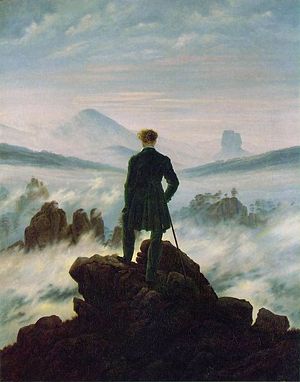
Romanticism was an artistic and intellectual motion that ran from the late eighteenth century through the nineteenth century. It stressed strong emotion every bit a source of aesthetic feel, placing emphasis on such emotions equally trepidation, horror, and the awe experienced in against the sublimity of nature. It elevated folk art, language, and custom, as well equally arguing for an epistemology based on usage and custom.
Romanticism arose every bit a reaction against the excessive rationalism of the Enlightenment. It drew upon the French Revolution'due south rejection of aristocratic social and political norms. It was likewise influenced by the theory of evolution and uniformitarianism, which argued that "the past is the cardinal to the present." Thus some Romantics looked back nostalgically to the sensibility of the Middle Ages and elements of art and narrative perceived to be from the medieval catamenia. The name "romantic" itself comes from the term "romance" which is a prose or poetic heroic narrative originating in the medieval.
The ideals of the French Revolution influenced the Romantic movement in other means. Romanticism elevated the achievements of what it perceived as misunderstood heroic individuals and artists that altered social club, and legitimized the private imagination as a disquisitional authorisation which permitted freedom from classical notions of grade in art.
Contents
- 1 Characteristics
- 2 Visual art and literature
- 3 Music
- 3.i Romanticism and music
- 3.2 Music after 1848
- 4 Nationalism
- 5 Run into also
- 6 Notes
- seven References
- 8 External links
- nine Credits
The flaw in the Enlightenment listen, represented by the moral philosophy of Kant with its overemphasis on intellect (reason) and will, was its disregard of the faculty of emotion which is and then fundamental to human life. Romanticism was the inevitable reaction to Enlightenment Rationalism. The artistic and literary works of the Romantic movement have lasting appeal, because the human being faculty of emotion runs stronger and deeper than the intellect or the will.
Characteristics
In a general sense, Romanticism refers to several singled-out groups of artists, poets, writers, musicians, political, philosophical and social thinkers and trends of the late eighteenth and early nineteenth centuries in Europe. This motion is typically characterized by its reaction confronting the Enlightenment; while the Enlightenment emphasized the primacy of reason, Romanticism emphasized imagination and strong emotion. Rather than an epistemology of deduction, the Romantics demonstrated elements of knowledge through intuition. A precise characterization and a specific clarification of Romanticism were objects of intellectual history and literary history for all of the twentieth century without the emergence of any neat measure out of consensus.
Did you lot know?
Romanticism, popular from the late eighteenth century through the nineteenth century, emphasized emotion and imagination in dissimilarity to reason that was the focus of the Enlightenment
Arthur Lovejoy attempted to demonstrate the difficulty of this problem in his seminal article "On The Discrimination of Romanticisms" in his Essays in the History of Ideas (1948); some scholars see romanticism as completely continuous with the present, some come across it as the countdown moment of modernity, some see it as the beginning of a tradition of resistance to the Enlightenment, and still others appointment it firmly in the direct backwash of the French Revolution. Maybe the most instructive and succinct definition comes from French symbolist poet, Charles Baudelaire: "Romanticism is precisely situated neither in choice of subject nor exact truth, but in a way of feeling."
Some modernist writers argue that Romanticism represents an attribute of the Counter-Enlightenment, a negatively charged phrase used to label movements or ideas seen by them equally counter to the rationality and objectivity inherent in the Enlightenment, and promoting emotionalism, superstition and instability.
More often than not, Romanticism can be understood as a pursuit for the value of beauty on the part of humans because they have the faculty of emotion. Of course, humans also have two other faculties: Intellect and will, which pursue the values of truth and goodness, respectively. But when intellect (reason) is emphasized 1-sidedly equally in the Enlightenment in the eighteenth century, and when will is stressed very much as in the moral philosophy of Immanuel Kant around the stop of the eighteenth century, human beings naturally react with their kinesthesia of emotion every bit in Romanticism.
Visual art and literature
In visual art and literature, "Romanticism" typically refers to the late eighteenth century and the nineteenth Century. The Scottish poet James Macpherson influenced the early evolution of Romanticism with the international success of his Ossian bicycle of poems published in 1762, inspiring both Johann Wolfgang von Goethe and the immature Walter Scott.
An early German influence came from Goethe, whose 1774 novel The Sorrows of Young Werther had immature men throughout Europe emulating its protagonist, a immature creative person with a very sensitive and passionate temperament. At that time Germany was a multitude of pocket-size separate states, and Goethe's works would have a seminal influence in developing a unifying sense of nationalism. Of import writers of early on German language romanticism were Ludwig Tieck, Novalis (Heinrich von Ofterdingen, 1799) and Friedrich Hölderlin. Heidelberg afterwards became a center of German romanticism, where writers and poets such as Clemens Brentano, Achim von Arnim, and Joseph von Eichendorff met regularly in literary circles.
Since the Romanticists opposed the Enlightenment, they often focused on emotions and dreams as opposed to rationalism. Other of import motifs in High german Romanticism are traveling, nature and ancient myths. Tardily High german Romanticism (of, for instance, Eastward. T. A. Hoffmann'south Der Sandmann—"The Sandman," 1817; and Eichendorff's Das Marmorbild—"The Marble Statue," 1819) was somewhat darker in its motifs and has some gothic elements.
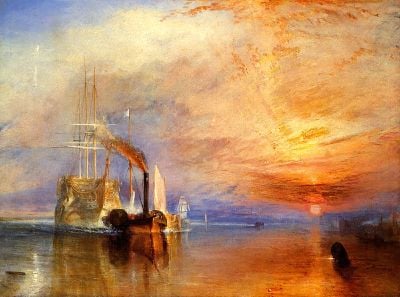
The fighting Temeraire tugged to her terminal berth to be broken upwards, painted 1839.
Romanticism in British literature developed in a different form slightly later, mostly associated with the poets William Wordsworth and Samuel Taylor Coleridge, whose co-authored volume Lyrical Ballads (1798) sought to reject Augustan poetry in favor of more than direct speech derived from folk traditions. Both poets were also involved in Utopian social thought in the wake of the French Revolution. The poet and painter William Blake is the well-nigh extreme example of the Romantic sensibility in Uk, epitomized by his claim, "I must create a system or be enslaved by another man'due south." Blake'south artistic work is also strongly influenced by medieval illuminated books. The painters Joseph Mallord William Turner and John Lawman are too more often than not associated with Romanticism.
Lord Byron, Percy Bysshe Shelley, Mary Shelley, and John Keats institute another phase of Romanticism in Britain. The historian Thomas Carlyle and the Pre-Raphaelite Alliance correspond the final stage of transformation into Victorian civilization. William Butler Yeats, born in 1865, referred to his generation equally "the last romantics."
In predominantly Roman Catholic countries, Romanticism was less pronounced than in Germany and Britain, and tended to develop later, subsequently the rise of Napoleon. François-René de Chateaubriand is often called the "Father of French Romanticism."
In France, the motion is associated with the nineteenth century, peculiarly in the paintings of Théodore Géricault and Eugène Delacroix, the plays, poems and novels of Victor Hugo (such as Les Misérables and Ninety-Three), and the novels of Stendhal. The composer Hector Berlioz is also of import.
In Russia, the principal exponent of Romanticism is Alexander Pushkin. Mikhail Lermontov attempted to analyze and bring to light the deepest reasons for the Romantic idea of metaphysical discontent with society and self, and was much influenced by Lord Byron. Pushkin's Eugene Onegin and Lermontov'southward Pechorin from A Hero of Our Time both were influenced by the "Byronic" pose, the boredom of the superior romantic hero. Both the poets would die in duels of honour. The poet Fyodor Tyutchev was besides an important figure of the movement in Russia, and was heavily influenced by the High german Romantics.
Romanticism played an essential office in the national enkindling of many Central European peoples lacking their ain national states, specially in Poland, which had recently lost its independence to Russia when its army crushed the Polish Rebellion under the reactionary Nicholas I. Revival of aboriginal myths, customs and traditions by Romantic poets and painters helped to distinguish their indigenous cultures from those of the dominant nations (Russians, Germans, Austrians, Turks, etc.). Patriotism, nationalism, revolution and armed struggle for independence as well became popular themes in the arts of this period. Arguably, the most distinguished Romantic poet of this part of Europe was Adam Mickiewicz, who developed an idea that Poland was the "Messiah of nations," predestined to suffer just as Jesus had suffered to salvage all the people.[1]
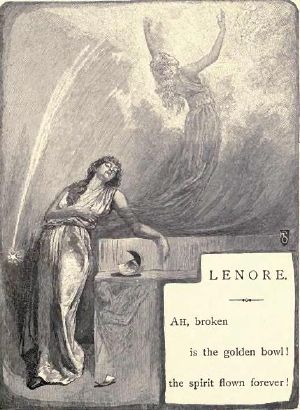
Illustration by Henry Sandham for Poe'south poem "Lenore" for an 1886 edition
In the United States, the romantic gothic makes an early on advent with Washington Irving'due south The Fable of Sleepy Hollow (1819), followed from 1823 onwards past the fresh Leatherstocking Tales of James Fenimore Cooper. They emphasized heroic simplicity and their fervent mural descriptions of an already-exotic mythicized frontier peopled past "noble savages" was similar to the philosophical theory of Jean-Jacques Rousseau, similar Uncas in Cooper's The Last of the Mohicans, for instance. There besides are picturesque elements in Washington Irving'southward essays and travel books.
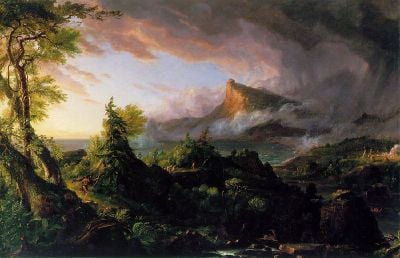
Edgar Allan Poe's tales of the macabre and his balladic poetry were more influential in France than at habitation, but the romantic American novel is fully developed in Nathaniel Hawthorne's temper and melodrama. Later Transcendentalist writers such as Henry David Thoreau and Ralph Waldo Emerson all the same show elements of its influence, as does the romantic realism of Walt Whitman. But past the 1880s, psychological and social realism was competing with romanticism. The poetry which Americans wrote and read was all romantic or heavily influenced by it until the rise of modernism in 1920s. This includes Poe and Hawthorne, also as Henry Wadsworth Longfellow. The verse of Emily Dickinson—most unread in her own time—and Herman Melville's novel Moby-Dick show the lingering influence of romantic themes, even as they evoked a more than realistic and sometimes deeply psychological and philosophical view of the world. Every bit elsewhere (England, Frg, France), American literary Romanticism had its counterpart in the visual arts, virtually peculiarly in the exaltation of untamed America establish in the paintings of the Hudson River School.
In the twentieth century, Russian-American author Ayn Rand called herself a romantic, and thought she might be a bridge from the Romantic era to an eventual esthetic rebirth of the movement. She wrote a volume chosen The Romantic Manifesto and called her own approach "Romantic realism."
Music
Romanticism and music
In general, the term "Romanticism" applied to music has come up to hateful the period roughly from the 1820s until 1910. The contemporary application of "romantic" to music did not coincide with modern categories. In 1810, E.T.A. Hoffmann called Mozart, Haydn, and Beethoven the three "Romantic Composers," while Ludwig Spohr used the term "good Romantic style" to apply to parts of Beethoven's Fifth Symphony. Past the early twentieth century, the sense that there had been a decisive suspension with the musical past led to the establishment of the nineteenth century as "The Romantic Era," and as such it is referred to in the standard encyclopedias of music.
However the twentieth century full general use of the term "romanticism" among music writers and historians did not evolve in the same style every bit it did amongst literary and visual arts theorists, so that there exists a disjunction betwixt the concept of romanticism in music and in the other arts. Literary and visual art theorists tend to consider romanticism in terms of the breach of the artist and the value of art for art'due south sake, concepts merely gradually creeping into musicology, where there is withal considerable confusion between "music of Romanticism" and the less definable, (maybe somewhat redundant) category of "music of the Romantic Era." The traditional discussion of the music of Romanticism includes elements, such equally the growing use of folk music, which are more directly related to nationalism and are only indirectly related to Romanticism.
Some aspects of Romanticism are already present in eighteenth-century music. The heightened contrasts and emotions of Sturm und Drang seem a precursor of the Gothic in literature, or the sanguinary elements of some of the operas of the period of the French Revolution. The libretti of Lorenzo da Ponte for Mozart, and the eloquent music the latter wrote for them, convey a new sense of individuality and freedom. In Beethoven, perchance the outset incarnation since the Renaissance of the artist equally hero, the concept of the Romantic musician begins to reveal itself—the man who, after all, morally challenged the Emperor Napoleon himself past striking him out from the dedication of the Symphony no. iii, the Eroica Symphony. In Beethoven's Fidelio he creates the apotheosis of the "rescue operas" which were another feature of French musical culture during the revolutionary menstruum, in social club to hymn the freedom which underlay the thinking of all radical artists in the years of hope after the Congress of Vienna.
Beethoven'southward use of tonal architecture in such a manner as to permit significant expansion of musical forms and structures was immediately recognized every bit bringing a new dimension to music. The afterward piano music and string quartets, especially, showed the way to a completely unexplored musical universe. The writer, critic (and composer) Hoffmann was able to write of the supremacy of instrumental music over vocal music in expressiveness, a concept which would previously have been regarded every bit absurd. Hoffmann himself, as a practitioner both of music and literature, encouraged the notion of music equally 'programmatic' or telling a story, an thought which new audiences establish attractive, however, irritating it was to some composers (for instance, Felix Mendelssohn). New developments in instrumental technology in the early on nineteenth century—iron frames for pianos, wound metal strings for string instruments—enabled louder dynamics, more than varied tone colors, and the potential for sensational virtuosity. Such developments swelled the length of pieces, introduced programmatic titles, and created new genres such as the free continuing overture or tone-poem, the piano fantasy, nocturne and rhapsody, and the virtuoso concerto, which became central to musical Romanticism. In opera a new Romantic atmosphere combining supernatural terror and melodramatic plot in a folkloric context was virtually successfully accomplished by Carl Maria von Weber's Der Freischütz (1817, 1821). Enriched timbre and colour marked the early orchestration of Hector Berlioz in France, and the grand operas of Giacomo Meyerbeer. Amongst the radical fringe of what became mockingly characterized (adopting Wagner'due south own words) as "artists of the hereafter," Liszt and Wagner each embodied the Romantic cult of the free, inspired, charismatic, possibly ruthlessly unconventional individual artistic personality.
Information technology is the flow of 1815 to 1848, which must be regarded as the truthful historic period of Romanticism in music—the age of the terminal compositions of Beethoven (d. 1827) and Schubert (d. 1828), of the works of Schumann (d. 1856) and Chopin (d. 1849), of the early on struggles of Berlioz and Richard Wagner, of the smashing virtuosi such as Paganini (d. 1840), and the young Franz Liszt and Sigismond Thalberg. Now that people are able to listen to the work of Mendelssohn (d. 1847) stripped of the Biedermeier reputation unfairly attached to it, he tin also be placed in this more appropriate context. Afterward this period, with Chopin and Paganini dead, Liszt retired from the concert platform at a minor German court, Wagner effectively in exile until he obtained royal patronage in Bavaria, and Berlioz still struggling with the bourgeois liberalism which all simply smothered radical artistic effort in Europe, Romanticism in music was surely past its prime—giving way, rather, to the period of musical romantics.
Music after 1848
Romantic nationalism—the argument that each nation had a unique individual quality that would be expressed in laws, customs, language, logic, and the arts—establish an increasing following after 1848. Some of these ideals, linked to liberal politics, had been exemplified in Beethoven's contempt to Napoleon's adoption of the title of emperor, and tin exist traced through to the musical patriotism of Schumann, Verdi, and others. For these composers and their successors the nation itself became a new and worthy theme of music. Some composers sought to produce or take part in a school of music for their own nations, in parallel with the establishment of national literature. Many composers would accept inspiration from the poetic nationalism nowadays in their homeland. This is evident in the writings of Richard Wagner, especially later 1850, simply can exist clearly seen in Russia, where the Kuchka (handful) of nationalist composers gathered effectually Mily Balakirev, including Modest Mussorgsky, Alexander Borodin, and Nikolai Rimsky-Korsakov. These composers were concerned about the enormous influence of German music in Russian federation, and they largely resented the founding of the conservatoires in Moscow and Saint Petersburg by the brothers Nikolai and Anton Rubinstein, which they believed would be Trojan horses for German language musical civilization (however, Russian romantic music is today now closely identified with Anton's favorite educatee, Pyotr Ilyich Tchaikovsky).
This move continued forward through into the twentieth century with composers such equally Jean Sibelius, although nationalism found a new musical expression in written report of folk-song which was to be a key chemical element in the development of Béla Bartók, Ralph Vaughan Williams, and others.
Labels like "Tardily Romantic" and "Postal service-Romantic" are sometimes used to link disparate composers of various nationalities, such as Giacomo Puccini, Jean Sibelius, Richard Strauss, Samuel Barber and Ralph Vaughan Williams, all of whom lived into the middle of the twentieth century. The witting "Modernisms" of the twentieth century all establish roots in reactions to Romanticism, increasingly seen as not realistic enough, even not brutal enough, for a new technological age. Yet Arnold Schoenberg's later spare style had its roots in rich freely chromatic atonal music evolving from his tardily Romantic style works, for example the giant polychromatic orchestration of Gurrelieder; and Igor Stravinsky's originally controversial ballets for Sergei Diaghilev seem to united states far less controversial today when we can sympathise their descent from Rimsky-Korsakov.
Nationalism
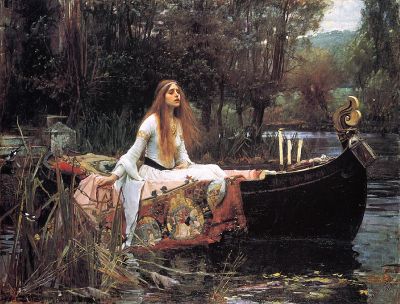
A Romantic heroine: The Lady of Shalott (1888). John William Waterhouse'due south realistic technique depicts a neo-medieval subject field drawn from Arthurian romance
1 of Romanticism's key ideas and most enduring legacies is the assertion of nationalism, which became a central theme of Romantic art and political philosophy. From the earliest parts of the movement, with their focus on evolution of national languages and folklore, and the importance of local customs and traditions, to the movements which would redraw the map of Europe and pb to calls for cocky-determination of nationalities.
Early Romantic nationalism was strongly inspired by Rousseau, and by the ideas of Johann Gottfried von Herder, who, in 1784, argued that geography formed the natural economy of a people and shaped their customs and society.
The nature of nationalism changed dramatically, however, after the French Revolution, with the rise of Napoleon, and the reactions in other nations. Napoleonic nationalism and republicanism were, at first, inspirational to movements in other nations: Cocky-decision and a consciousness of national unity were held to be 2 of the reasons why French republic was able to defeat other countries in battle. Simply equally the French Democracy became Napoleon's Empire, Napoleon became not the inspiration for nationalism, but the objection to information technology.
In Prussia, the evolution of spiritual renewal as a means to appoint in the struggle against Napoleon was argued past, amid others, Johann Gottlieb Fichte a disciple of Immanuel Kant. The word Volkstum, or nationality, was coined in German as part of this resistance to the at present conquering emperor. Fichte expressed the unity of language and nation in his thirteenth address "To the German Nation" in 1806:
Those who speak the aforementioned language are joined to each other by a multitude of invisible bonds past nature herself, long earlier any human art begins; they sympathise each other and have the power of continuing to make themselves understood more and more than conspicuously; they belong together and are by nature i and an inseparable whole. …Only when each people, left to itself, develops and forms itself in accordance with its own peculiar quality, and merely when in every people each individual develops himself in accordance with that mutual quality, too as in accordance with his own peculiar quality—then, and and then only, does the manifestation of divinity appear in its truthful mirror as it ought to be.[2]
Run across also
- Folklore
- Nation-country
- Pre-Raphaelite Brotherhood
- Hudson River School
Notes
- ↑ Dorota Zakrzewska, Alienation and Powerlessness: Adam Mickiewicz'south "Ballady" and Chopin'southward Ballades Shine Music Journal ii:ane-2 (1999). Retrieved April xi, 2022.
- ↑ Johann Gottlieb Fichte, Addresses to the German Nation (Cambridge University Press, 2009, ISBN 0521448735).
References
ISBN links support NWE through referral fees
- Abrams, Meyer H. The Mirror and the Lamp: Romantic Theory and the Critical Tradition. New York, NY: Oxford University Press, 1971. ISBN 0195014715
- Brion, Marcel. Art of the Romantic Era: Romanticism, Classicism, Realism. New York, NY: Henry Holt & Company, Inc., 1966. ISBN 0275420906
- Fichte, Johann Gottlieb. Addresses to the German language Nation. Cambridge University Press, 2009. ISBN 0521448735
- Friedlaender, Walter. David to Delacroix. Nabu Press, 2011. ISBN 978-1175814777
- Novotny, Fritz. Painting and Sculpture in Europe, 1780-1880 New Haven, CT: Yale Academy Press, 1971. ISBN 0300053215
External links
All links retrieved July April 11, 2022.
- The Romantic Poets
- Romantic Circles
- Romanticism English Department, Brooklyn College.
- Romanticism The Metropolitan Museum of Art.
Credits
New Globe Encyclopedia writers and editors rewrote and completed the Wikipedia article in accordance with New World Encyclopedia standards. This article abides by terms of the Creative Commons CC-past-sa 3.0 License (CC-by-sa), which may be used and disseminated with proper attribution. Credit is due nether the terms of this license that can reference both the New Globe Encyclopedia contributors and the selfless volunteer contributors of the Wikimedia Foundation. To cite this article click here for a list of acceptable citing formats.The history of before contributions by wikipedians is accessible to researchers hither:
- Romanticism history
The history of this article since it was imported to New World Encyclopedia:
- History of "Romanticism"
Notation: Some restrictions may apply to use of individual images which are separately licensed.
Source: https://www.newworldencyclopedia.org/entry/romanticism
0 Response to "Romantic Art Rebelled Against the Age of Reason and Stressed"
Post a Comment